The DIDit Paradox – When Digital Sovereignty Burns the Planet
The Hater Blind Spot #
For years, the Linux and open-source communities have waited for their "daylight"; a moment where the world finally sees the danger of the Big Tech silos. With the rise of the #DIDit (Digital Independence Day) movement, sparked by the cultural momentum of Marc-Uwe Kling, that moment has arrived. People are deleting their Meta accounts, ditching Windows, and proudly announcing they now host their own Mastodon or Nextcloud instances.
But there is a bitter irony here. In the rush to show off their independence to Microsoft and Google, many tech-sovereign advocates are ignoring the massive environmental ledger they are creating. While they escape the "claws" of the Big Five, they are often replacing highly optimized infrastructure with fragmented, energy-hungry chaos.
The Efficiency Trap: Scaling Matters #
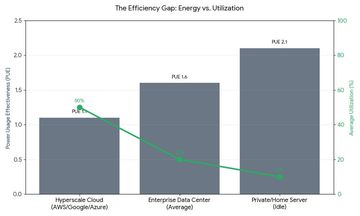
The hard truth is that sharing is almost always greener than owning. Hyperscale data centers (AWS, Google, Azure) operate with a Power Usage Effectiveness (PUE) as low as 1.09. This means nearly every watt goes directly into computing.
In contrast, the average private server or "home cloud" setup is often an ecological disaster:
- Idle Power Waste: A private instance typically sits at 5–15% utilization, yet it burns power 24/7.
- Utilization Gap: Cloud providers can do 3 to 5 times more work per watt than a standard enterprise or home-managed server.
- Thermal Inefficiency: Without professional, climate-optimized cooling, private hardware wastefully converts electricity into heat rather than bits.
To put it bluntly: Running your own server just to prove you don't need a billionaire's cloud is like driving a private diesel truck to work every day just to prove you don't need the public bus system. It is independent, but it is ecologically irresponsible.
{
  "key_insight": "Hyperscale efficiency vs. Fragmented waste",
  "pue_hyperscale": 1.09,
  "pue_private_avg": 2.1,
  "efficiency_delta": "Professional cloud is up to 4x more energy efficient"
}
European Hosters: A Better Middle Ground? #
If you want to be free from the US "Oligarchs" without burning the planet, you don't have to host it under your desk. Several European providers offer a more sustainable path to sovereignty:
| Provider | Origin | Sustainability Profile | Professional Focus |
|---|---|---|---|
| Hetzner | Germany | Uses 100% renewable energy from wind and water in its German and Finnish parks. | High performance/price ratio for VPS and dedicated servers. |
| OVHcloud | France | Vertically integrated; they build their own servers and use innovative water-cooling to reduce PUE. | Broad range of managed services with data sovereignty. |
| Scaleway | France | Extreme focus on circular economy and solar-powered data centers; highly transparent footprint. | Developer-friendly and Green IT leadership. |
| IONOS | Germany | Major player focusing on enterprise reliability with 100% green energy in many regions. | Stability and GDPR compliance for larger business structures. |
Audit Checklist: Is Your Sovereignty Sustainable? #
Before you declare your digital independence, run this quick audit to see if you are replacing the "plague" with "cholera."
- [ ] Provider Energy Mix: Is your hoster using 100% certified renewable energy?
- [ ] PUE Transparency: Does your provider publish a PUE below 1.2? (Lower is better).
- [ ] Utilization Check: Is your server utilization consistently above 30%? If lower, consider moving to a shared/managed environment.
- [ ] Location Matters: Is the data center located in a region with a low-carbon grid (e.g., France, Nordic countries)?
- [ ] Hardware Life Cycle: Are you using refurbished hardware or extending the life of your devices?
- [ ] Managed vs. Raw: Can you achieve your sovereignty goals through a managed European service rather than a dedicated, idle machine?
Sources and References #
- IEA: Data Centres and Data Transmission Networks Report 2025
- Uptime Institute: Annual Global Data Center Survey Results
- Electricity Maps: Real-time Carbon Intensity of Global Power Grids
- Green IT Global: The Efficiency Paradox of Decentralization
- Circular Electronics Partnership: Roadmap for Hardware Lifecycles
- Digital Independence Day (#DIDit) Campaign - Marc-Uwe Kling